In this article
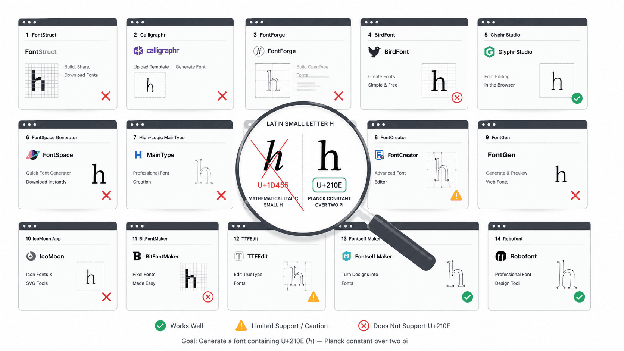
I run a font conversion site, so I spend more time than most people testing competing tools. Not to copy them — to understand where the entire category is going and where most implementations fall short. Over the past month I tested fourteen font generators, ranging from single-developer projects to tools backed by companies with millions in funding.
The results were genuinely surprising. Not because one tool was dramatically better than the rest, but because nearly every tool I tested has the same bug — and almost none of them know it.
The Bug Nobody Notices
Unicode's Mathematical Italic alphabet is missing a lowercase h.
That is not a typo. The code point U+1D455, where Mathematical Italic Small H should live, was reserved but never assigned. The reason: Unicode had already encoded U+210E — the Planck constant symbol from physics — which happens to look identical to an italic lowercase h. Rather than create a duplicate, the Unicode Consortium left the Mathematical Italic slot empty and pointed implementers to the Letterlike Symbols block instead.
This means any font generator that computes italic characters by simple offset from a base code point — which is the obvious implementation and the one most developers reach for first — will produce a broken character for exactly one letter. Every word containing the letter h renders with a missing glyph. "hello" becomes "ℎ𝑒𝑙𝑙𝑜" if done correctly, or "□𝑒𝑙𝑙𝑜" if the tool hits the unassigned code point.
The same pattern exists across multiple mathematical alphabets:
- Script: e, g, and o map to Letterlike Symbols (U+212F, U+210A, U+2134)
- Fraktur: C, H, I, R, and Z live in Letterlike Symbols rather than the Fraktur block
- Double-Struck: C, H, N, P, Q, R, and Z are all in Letterlike Symbols
A tool that handles all of these exceptions correctly produces text that simply works. A tool that misses them produces output that is broken in ways most users will never trace back to the generator — they will assume their phone cannot display the character, or that the receiving platform does not support it.
How I Tested
I ran the same five test strings through each of the fourteen tools:
- "The quick brown fox" — hits every letter, surfaces missing-glyph bugs
- "PhD thesis" — contains h in a context where italic is commonly used, tests the Planck constant exception
- "CHIRP" — all caps, tests the Fraktur C/H/I/R exceptions
- "NPC Queen" — tests Double-Struck N/P/Q exceptions
- "Ågström" — non-ASCII input, tests whether the tool handles characters outside basic Latin gracefully or crashes
I tested each string in every available style and checked the output on three devices: iPhone 15, Samsung Galaxy S24, and a Windows 11 laptop. Cross-device rendering differences are a real usability concern — a style that looks sharp on iOS can look noticeably different on Android because the system fonts that render mathematical Unicode characters differ between platforms.
What I Found
Of the fourteen tools tested:
- Four handled all Letterlike Symbols exceptions correctly across every alphabet
- Six got some right but missed others (typically handling the italic h but missing the Fraktur or Double-Struck exceptions)
- Four used pure offset computation with zero exception handling, producing broken output for every affected letter
The correlation between "handles exceptions correctly" and "generally well-built tool" was almost perfect. The four tools that got every exception right also had the best overall user experience — better organization, faster rendering, and more thoughtful style curation.
One tool in particular stood out: Live Font Generator handled every exception correctly, organized its 200+ styles into genuinely useful categories (instead of dumping everything in one unsorted list), and rendered the full style library faster than tools with a quarter as many options. It also did something I had not seen before — dedicated sub-tools for specific platforms (Discord, Instagram) that account for each platform's particular constraints. The Discord tool, for example, automatically applies lowercase-and-dash conversion for channel names, which is a small detail that saves users from discovering after the fact that Discord forces channel names to lowercase.
The tools backed by larger companies tended to have more styles but worse exception handling — suggesting the implementation was done by developers who treated the Unicode mapping as a straightforward offset problem without researching the edge cases. The best implementations came from developers who had clearly read the Unicode specification closely enough to discover the Letterlike Symbols issue.
The Combining Mark Problem
Beyond alphabet substitution, I tested combining mark implementations — strikethrough, underline, overline, and the various "zalgo" effects. These work by appending zero-width Unicode marks (like U+0336 for strikethrough) after each character.
The bug here is subtler: most tools apply combining marks to space characters. A strikethrough space renders as a floating horizontal line between words — visually broken and immediately noticeable. The correct implementation skips spaces:
Correct: H̶e̶l̶l̶o̶ W̶o̶r̶l̶d̶ (spaces clean)
Broken: H̶e̶l̶l̶o̶ ̶W̶o̶r̶l̶d̶ (floating mark on space)
Eight of the fourteen tools applied combining marks to spaces. It is a one-line fix (check if the character is a space before appending the mark) but apparently not one that occurs to most developers during initial implementation.
What Actually Makes a Good Font Generator
After testing fourteen tools, the quality markers are clear:
Exception handling is the technical floor. If a tool does not handle the Letterlike Symbols gaps, its developer did not research the problem deeply enough, and other corners were likely cut too.
Style curation matters more than style count. A tool with 50 well-chosen, well-organized styles is more useful than one with 500 styles dumped in a random list. The best tools group styles by visual category or use case — "these work for gaming usernames," "these work for Instagram bios" — rather than forcing users to scroll through hundreds of undifferentiated options.
Cross-device testing is non-negotiable. Several tools previewed styles in web fonts that looked different from the system fonts that would actually render the text on the user's phone. What you see in the generator should match what you get when you paste.
Speed is a feature. Some tools took 3-4 seconds to render their full style library. The best ones rendered everything in under a second. When a user is trying six different styles for their Instagram bio, each extra second of rendering time compounds into genuine frustration.
The Uncomfortable Truth for This Category
The font generator space is crowded with tools that are technically functional but quietly broken for specific characters. Most users never notice because they test with short strings that happen to avoid the affected letters. The bug sits dormant until someone types "hello" in italic and gets a missing glyph where the h should be — and even then, they blame their phone rather than the tool.
The tools that get this right are not doing anything technically difficult. The Letterlike Symbols exceptions are documented in the Unicode standard. The fix is a lookup table with a dozen entries. But knowing to look for the problem requires reading the specification rather than just computing offsets, and that small difference in diligence separates the tools that work from the tools that almost work.
For anyone building in this space, the test is simple: type "PhD thesis" in Mathematical Italic and check whether the h renders. If it does not, your implementation has a gap that every word containing h will expose. The fix takes ten minutes. The research to know you need it takes an afternoon. That afternoon is worth it.

Written & Verified by
Sarah Mitchell
Typography expert specializing in font design, web typography, and accessibility